According to IEEE power quality standards (IEEE 1159) and the IEC 61000 series, utility power is subject to disturbances such as sags, swells, transients, harmonics, and interruptions.
But what many don’t realise is that power problems go far beyond simple blackouts or voltage spikes. Hidden within the daily flow of electricity are distortions, dips, noise, and irregular waveforms that quietly damage equipment, shorten component lifespan, and cause unpredictable system failures.
These issues are often misunderstood because they don’t always announce themselves with dramatic outages. Instead, they show up as intermittent reboots, corrupted data, unexplained downtime, or servers that “just don’t behave right.”
At Right Power Technology, we suggest engineers deserve a clear, technical, and complete explanation of these phenomena so this guide breaks down the 9 critical power quality issues, how they affect IT equipment, and what type of UPS technology actually protects against them.
1. Blackouts (Total Loss of Power)
What it is:
A complete loss of utility power, typically lasting from milliseconds to hours.
Why it matters:
- Servers shut down abruptly
- Data corruption
- Hardware stress during sudden power loss and recovery
Mitigation:
A True Online Double Conversion UPS, which provides seamless transfer with zero transfer time.
2. Voltage Sags (Dips)
What it is:
A temporary drop in voltage, often caused by large loads starting (motors, air conditioners, industrial equipment).
Typical duration: 3 ms to several seconds.
Impact on IT equipment:
- Devices trip or reboot
- Power supplies run unstable
- Sensitive electronics malfunction under low voltage
Mitigation:
A UPS with automatic voltage regulation and continuous output voltage under fluctuating input.
3. Voltage Swells
What it is:
A short-term voltage increase above the nominal range.
Common causes:
Faults on the grid, load switching, sudden removal of large loads.
Impact:
- Stress on components
- Overheating of PSUs
- Shortened equipment lifespan
Mitigation:
True Online Double Conversion UPS, which isolates output from input variations.
4. Surges & Spikes
What it is:
Very brief voltage spikes caused by lightning, switching, or grid instability.
Duration: Microseconds.
Impact:
- Instant damage to sensitive chips
- Burnt power supplies
- Degraded insulation over time
Mitigation:
UPS systems equipped with surge protection and input filtering.
5. Harmonic Distortion
What it is:
Distortion of the electrical waveform caused by non-linear loads — especially modern IT and data centre equipment.
Why it’s dangerous:
- Overheats transformers and cables
- Causes neutral conductor overload
- Reduces efficiency
- Creates unpredictable behaviour in sensitive electronics
Harmonics are becoming more common, not less, as high-density compute grows.
Mitigation:
A UPS with IGBT rectifier, active filtering, and clean sinusoidal output.
6. Electrical Noise (Common-Mode and Normal-Mode)
What it is:
High-frequency interference introduced by nearby devices, motors, radio systems, or poor grounding.
Impact:
- Data transmission errors
- Sensitive digital systems freeze or behave erratically
- Storage devices fail during write cycles
Mitigation:
UPS with complete isolation transformers or high-grade noise filtering.
7. Frequency Variations
What it is:
Shifts from the standard 50/60Hz frequency. Common when generators or unstable grids are involved.
Impact:
- Motors and power supplies run inefficiently
- Cooling systems behave unpredictably
- Some equipment fails to synchronise
Mitigation:
Online UPS with independent output frequency regulation.
8. Voltage Undershoots / Overvoltage Recovery Transients
What it is:
A sharp temporary drop or rise in voltage during switching events.
Example:
When power returns after an outage, equipment experiences sudden voltage overshoot.
Impact:
- Stress on power supply capacitors
- Event-driven equipment failures that are hard to trace
- “Boot-loop behaviour” on servers
Mitigation:
UPS with voltage smoothing and output regulation during transient events.
9. Switching Transients & Notches
What they are:
Brief waveform distortions caused by heavy electrical switching, rectifiers, or industrial equipment.
Duration: Nanoseconds to milliseconds.
Impact:
- Logic errors in CPUs
- Sensitive devices reset
- Communication failures
- PLC and automation systems glitch
Mitigation:
UPS with double conversion topology, which reconstructs a clean output waveform regardless of input noise.
Why IT Engineers Need to Understand All 9 Issues
Many organisations believe they only need protection from blackouts.
In reality, the small and frequent anomalies cause more damage than the rare big failures.
Real-world examples include:
- Servers randomly rebooting due to sags
- Storage arrays failing because of harmonics
- Network switches freezing under electrical noise
- High-density racks overheating due to distorted input power
- Data corruption caused by millisecond-level transients
These issues are often misdiagnosed as “hardware failures”, when the root cause is poor power quality.
By understanding all 9 types of anomalies, engineers can design more stable IT environments and reduce long-term risk.
The Engineering Perspective: Why Double Conversion is the Standard Solution
Across all nine power quality issues, only one UPS architecture consistently protects against every anomaly:
True Online Double Conversion UPS
This technology continuously converts incoming AC to DC and back to AC, effectively creating a new, stable, regulated power source that is independent of the grid.
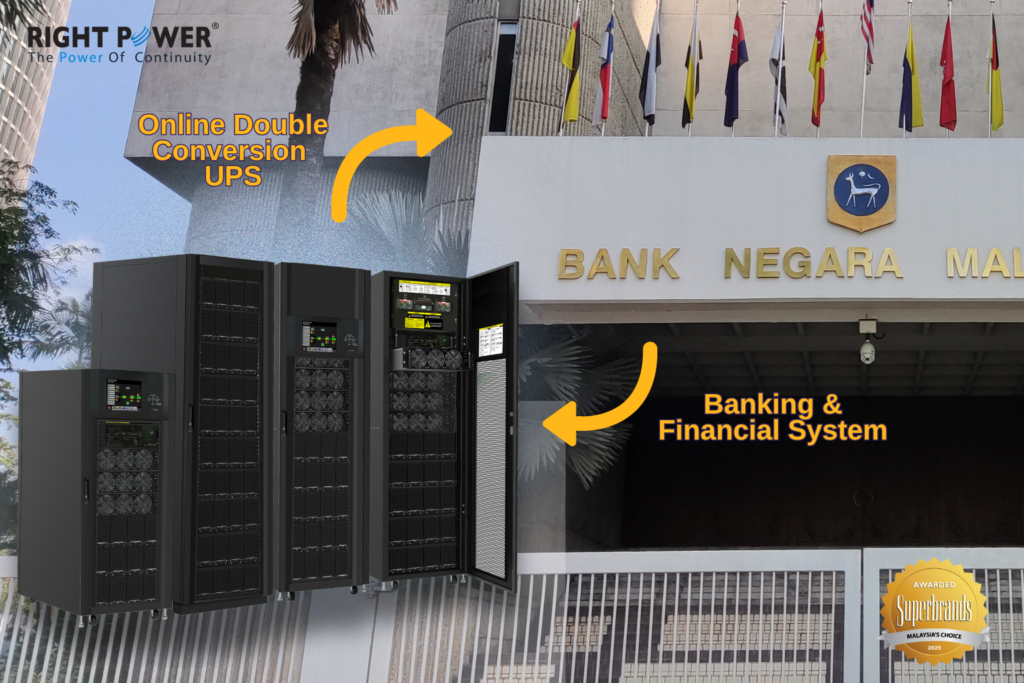
This is why high-availability data centres, hospitals, financial institutions, and industrial automation environments rely on it.
At RPT, this architecture is the core of our X-Series UPS, but the focus here is not the product it’s the engineering principle:
If you want protection against all 9 power anomalies, double conversion is the only complete solution.
Conclusion
The grid may appear stable, but for IT systems, it is filled with hidden distortions, dips, and interruptions that slowly degrade performance and reliability. Understanding these nine categories of power quality issues gives engineers the knowledge they need to build resilient infrastructure.
Equipment does not fail by accident, it fails because the power feeding it is not as clean as it appears. A well-planned UPS strategy is not just about backup runtime; it’s about controlling the quality of the power that reaches every device.
Find more about: