At 9:14 AM on a Tuesday, a DuitNow transfer leaves a customer’s account. At the same moment, an AI credit scoring engine processes thousands of data points while a fraud detection system verifies a cross border transaction in milliseconds. Inside the bank’s server room, every transaction is being processed, verified, and recorded continuously in real time.
This is how fast Malaysia’s financial infrastructure operates today, and at this speed, there is no room for error.
Malaysia’s digital banking sector is growing rapidly. Ryt Bank, the country’s first AI powered bank, surpassed 1.2 million users within seven months and processed more than 25 million transactions. GXBank also recorded RM2.16 billion in customer deposits within its first nine months. Malaysian banks are now gaining international recognition for AI driven payments, fraud prevention, and open banking technology.
Behind all these digital services is a power infrastructure most people never think about until something goes wrong.
The Threat Nobody Puts in the Risk Register
Bank IT managers spend heavily on protecting systems from cyberattacks, software failures, and compliance risks. However, one major threat is often overlooked: unstable power entering the building.
In financial environments, power disturbances are usually small and almost impossible to notice. Brief voltage fluctuations, minor sags, and harmonic distortions may last only milliseconds, but they can still interrupt sensitive data processes during execution.
The result is often data packet loss, incomplete transaction records, database write errors, or timestamp mismatches between systems. The transaction itself may still be valid, but the recorded data can become corrupted at the moment the power disturbance occurs.
Unlike a major system failure, these issues are harder to detect immediately. They may only surface hours or days later, forcing IT teams to perform manual investigations, rebuild audit trails, and manage compliance reporting. For banks processing massive transaction volumes daily, even a small number of corrupted records can create serious operational and regulatory risks.
Why 10 Milliseconds Is Too Slow for Modern Finance
Many IT professionals see a UPS as simply a backup power device, but not all online UPS systems provide the same level of protection. In modern financial systems, even a few milliseconds can make a major difference.
A conventional line interactive UPS switches to battery power when it detects a disturbance, usually within 2 to 10 milliseconds. For normal office equipment, this delay is hardly noticeable. However, for high speed banking systems, AI fraud detection, and real time transaction processing, that short gap can still cause data corruption or incomplete transaction records.
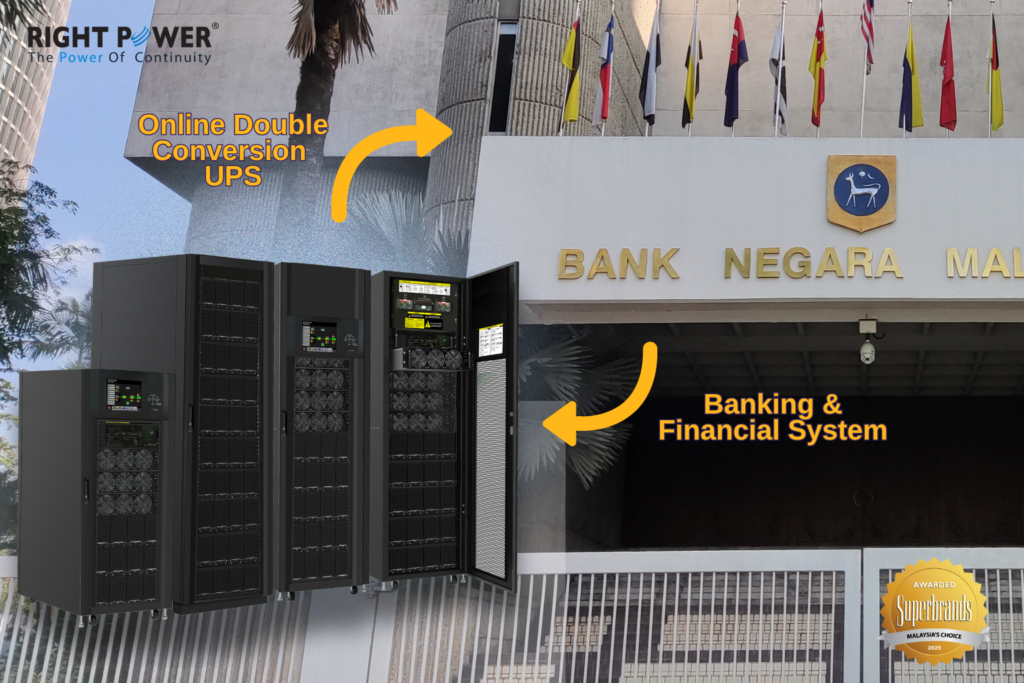
This is why many financial institutions rely on Online Double Conversion UPS technology. Instead of switching during a power disturbance, this system continuously converts and regulates power before supplying it to connected equipment. As a result, the equipment always receives stable and clean power.
Because the load is constantly powered through the UPS inverter, there is no transfer delay when utility power fluctuates or fails. The transfer time is effectively zero, making Online Double Conversion UPS systems ideal for mission critical financial environments where data integrity cannot be compromised.
What “Clean Power” Actually Means for Financial Infrastructure
The zero transfer time of Online Double Conversion UPS technology is only part of the advantage. For financial infrastructure, the quality of the power itself is just as important.
The double conversion process acts like a protective barrier between the utility supply and connected equipment. Power disturbances such as voltage sags, swells, harmonic distortion, and frequency fluctuations are filtered out before they reach servers or storage systems. The equipment then receives stable and regulated pure sine wave power, even when the incoming supply is unstable.
For financial systems, this level of clean power is critical because it helps protect sensitive servers, transaction databases, AI driven systems, and real time processing platforms from disruptions that could affect performance or data integrity.
Database write integrity
Storage systems and database servers require stable, consistent power to complete write operations without corruption. Voltage variations during a write cycle can produce incomplete records that are difficult or impossible to detect immediately.
Clock synchronisation
Financial transaction systems depend on precise timestamps for sequencing, audit trails, and regulatory reporting. Power disturbances can cause timestamp drift between systems that were operating simultaneously, creating reconciliation discrepancies that have no obvious cause.
Network switch stability
The switches and routers that carry transaction data between systems must remain continuously online. A brief power event on a network switch can cause packet retransmission, connection resets, and data delays that compound across a high-volume transaction environment.
AI processing continuity
AI-driven systems managing fraud detection, credit scoring, and customer interaction operate on continuous inference cycles. An interruption mid-inference does not simply pause the process — it invalidates the state, requiring a cold restart that carries its own latency and reliability implications.
The IT Manager’s Invisible Responsibility
For IT professionals managing financial infrastructure, power quality is often the least visible part of the job. Servers, networks, and cybersecurity systems receive most of the attention, while the UPS system in the server room is usually overlooked.
However, as Malaysia’s digital payment transactions continue to grow rapidly, maintaining stable and reliable power has become critical for protecting data integrity and system performance. Choosing the right UPS system is not just a procurement decision but an important risk management decision.
In high frequency financial environments, a standard line interactive UPS may not provide enough protection against power disturbances. An Online Double Conversion UPS delivers stable and continuous power, helping ensure that transaction records, AI systems, and real time banking services remain reliable under all conditions.
The Standard for Financial Infrastructure Power Protection
For financial institutions and fintech operators evaluating or reviewing their power protection strategy, three criteria should be non-negotiable:
Zero transfer time
Only Online Double Conversion topology delivers this. Any UPS with a stated transfer time, however short, is not suitable for high-frequency transaction systems.
Output voltage regulation within ±2%
Financial-grade equipment requires stable, consistent input voltage. The double conversion process maintains output within this tolerance regardless of incoming supply quality.
Continuous monitoring with SNMP integration
Power events should be logged, timestamped, and accessible to network management systems. Visibility into the power environment is part of a complete audit trail for regulated financial infrastructure.
Invisible, Until It Isn’t
The best power protection in a financial environment is the kind nobody notices. No alerts, no reconciliation issues, and no incident reports. Just clean and continuous power delivered reliably every second of the operating day.
That level of reliability does not happen by accident. It is carefully engineered, and for Malaysia’s rapidly growing digital financial infrastructure, getting it right is no longer optional.
Find more about: