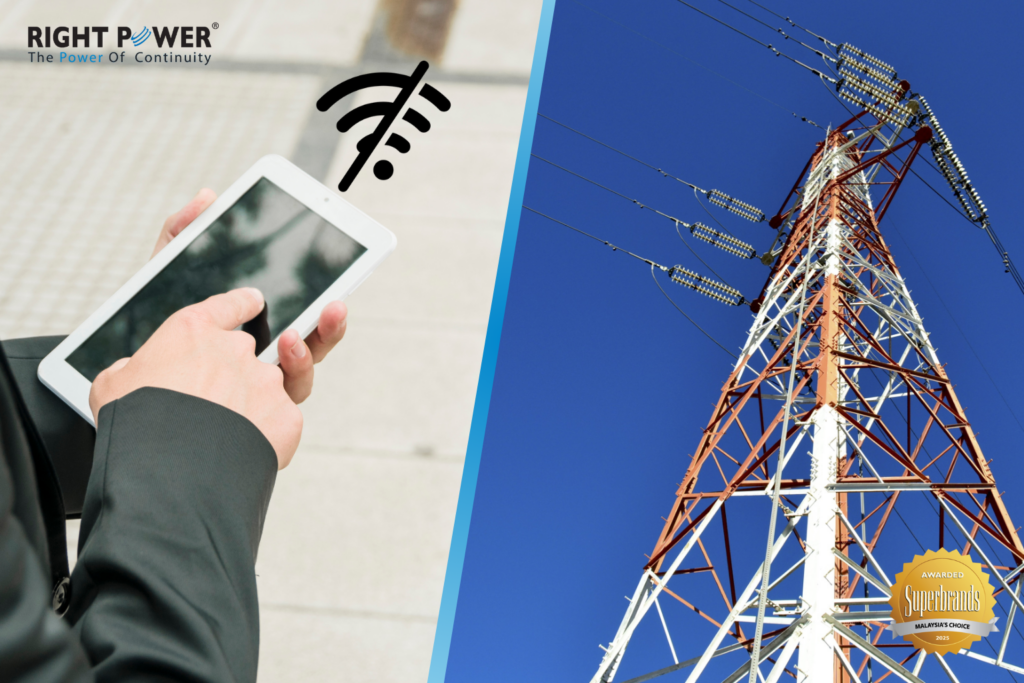
You have probably experienced it before — the lights flicker for a brief second, your air conditioner lets out a strange hum, or your desktop computer suddenly restarts for no apparent reason. Most of us brush it off as a minor inconvenience. What we rarely stop to consider is what is happening inside our devices at that exact moment.
At Right Power, we have spent years studying how Malaysia’s electrical grid behaves in real-world conditions. And what we have found should concern every homeowner, IT manager, and business owner who relies on modern electronics.
The Unseen Enemy: Voltage Fluctuation
Malaysia’s national grid nominally delivers 240V at 50Hz. In an ideal world, every socket in your home or office would consistently output that exact figure. But the real world is far messier.
Grid voltage can swing dramatically — dipping as low as 150V during peak demand hours, or spiking as high as 260V during sudden load drops or lightning-induced surges. These fluctuations happen in milliseconds. Your eyes may not catch the flicker, but your devices certainly feel it.
This is what engineers call voltage instability, and it is one of the most underappreciated causes of premature hardware failure in Malaysia.
What Happens to Your Electronics During a Voltage Swing?
Modern electronics are precision instruments. Your refrigerator’s inverter compressor, your server rack’s power supply, and your smart TV’s processing board are all designed to operate within a tight voltage tolerance, typically around ±10 percent of their rated input.
When voltage rises above this range, the extra electrical energy is absorbed by internal components such as capacitors, resistors, and integrated circuits. This energy turns into heat. A strong spike can damage components instantly, while repeated smaller spikes slowly wear them down. Over time, this thermal stress shortens the lifespan of your equipment, often before any obvious signs appear.
When voltage drops below the rated range, the damage happens differently. Electric motors and compressors found in refrigerators, air conditioners, water pumps, and industrial machines start drawing more current to maintain performance. Higher current creates more heat, and sustained low voltage forces these systems to operate under constant stress. This is one of the most common causes of compressor failure in many Malaysian homes.
The physics is simple. Whether your appliance is affordable or premium, unstable voltage places extra strain on internal components and gradually reduces reliability and lifespan.
The Engineering Solution: How the AVS RPS Series Works
This is exactly the problem the Right Power AVS RPS Series was designed to solve. Here are the key technologies inside the system:
• Relay Topology
Relay based topology uses electromagnetic relays to switch between transformer taps in real time. When incoming voltage changes, the AVS RPS Series detects it and instantly adjusts the output. The switching happens within milliseconds, fast enough to stabilise power before your devices are affected. This method is more responsive and energy efficient than older servo motor regulators, which rely on mechanical movement and wear down over time.
• Toroidal Transformer
At the core of the AVS RPS Series is a toroidal transformer with a circular, doughnut shaped design. This structure creates a closed magnetic path that reduces electromagnetic interference. This is especially important for sensitive electronics such as medical equipment, audio systems, and network devices. Toroidal transformers also run cooler, operate quietly, and offer better energy efficiency, helping deliver clean and stable power.
• Boost and Buck Logic
The AVS RPS Series automatically boosts voltage when it drops too low and reduces it when it becomes too high. This ensures a stable output of around 230V within a tight tolerance, even when the incoming voltage fluctuates significantly. As a result, your equipment receives consistent and reliable power at all times.
The 6 Second Compressor Delay: A Small Feature That Saves Big Money
This is a small feature that is often overlooked, but it plays a major role in protecting refrigerators and air conditioners. The AVS RPS Series includes a built in 6 second delay before restoring power after an interruption.
• Prevents Compressor Stress
When power is suddenly cut and restored, the pressure inside a compressor does not immediately stabilise. Refrigerant remains in a high pressure state, and restarting too quickly forces the compressor to work harder than it was designed for. This creates immediate mechanical stress.
• Automatic 6 Second Delay
The AVS RPS Series automatically waits 6 seconds before restoring power. This short pause allows internal pressure to equalise, ensuring the compressor restarts under safe and normal conditions.
• Extends Equipment Lifespan
This small delay can significantly reduce wear and tear on compressors. Over time, it helps extend the lifespan of expensive appliances such as refrigerators and air conditioners, potentially saving thousands in repair or replacement costs.
Not a Luxury — A Baseline Requirement
There is a tendency to view voltage regulators as optional accessories — something you buy for a server room but not for your home office or restaurant kitchen. That thinking belongs to a different era.
Today, almost every device with a price tag above a few hundred ringgit contains either a microprocessor or a motor-driven compressor. Your CCTV NVR, your POS terminal, your chest freezer, your network switch, your CNC machine — all of them are operating in the same unstable grid environment.
The AVS RPS Series is not a premium upgrade. It is the engineering baseline that your existing investments deserve.
Conclusion
Voltage fluctuation is not a rare event in Malaysia. It is a daily reality. The question is not whether your devices are being exposed to it. They are. The real question is whether they are being properly protected.
At Right Power, we designed the AVS RPS Series for exactly this environment: the fluctuating, unpredictable, real-world Malaysian grid. Understanding the science behind voltage instability is the first step. Acting on that understanding is what keeps your equipment running for years to come.