Imagine if this happened to you. It is 8:47 PM on a Friday night. Your retail floor is packed. The queue at the counter stretches back past the second aisle. Your cashier taps the screen to confirm payment and nothing happens. The POS terminal freezes. The customer’s card has been tapped but the receipt will not print. The screen just sits there, spinning.
Behind that customer, eleven more people are waiting.
This is not a software crash. Your system did not get hacked. Nobody forgot to pay the subscription. What happened was something far more invisible — and far more common than most retailers realise.
The Real Culprit: The Micro Brownout
Most people recognise a power outage. The lights go off, devices shut down, and the problem is obvious. Micro brownouts are different and far more difficult to detect.
• Ultra Short Voltage Drops
Micro brownouts are brief dips in voltage that last from milliseconds to less than a second. They happen quickly and often go completely unnoticed.
• No Visible Warning Signs
Lights do not flicker and equipment appears to run normally. To anyone in the room, nothing seems to have happened.
• Hidden Risk to POS Systems
Even though there are no visible signs, these voltage dips can disrupt sensitive systems like POS terminals, causing errors, slowdowns, or unexpected interruptions.
What a 0.5 Second Voltage Dip Does to a Cloud Syncing POS
Modern POS systems rely on constant communication with cloud servers. Even a brief voltage dip can interrupt this process and create hidden problems.
• Continuous Cloud Communication
Every payment sends data from the POS terminal to the router, through the internet, and to a cloud server for validation and confirmation. This process depends on uninterrupted connectivity.
• Router Resets During Micro Brownouts
When a micro brownout occurs, the router may not shut down but can briefly reset. During this short window, any data being transmitted can be lost without warning.
• Transactions Enter Limbo
The payment may be processed at the terminal, but the confirmation never reaches the cloud server. The customer is charged, but the transaction is not recorded in your system.
• Small Glitches Become Big Losses
One missed transaction may seem minor. However, during busy periods with hundreds of payments, these silent disruptions can quickly add up and create serious operational and financial issues.
The Real Cost Is Not the Downtime, It Is the Desync
Retailers often think power problems only cause downtime. Lost sales during a blackout are a concern, but the bigger risk for cloud based POS systems is desynchronization, when your terminal and server no longer match.
To understand how quickly this chain reaction happens, take a look at the flowchart below. What starts as an invisible 0.5 second voltage dip ends with wrong sales reports, duplicate refunds, and frustrated customers walking out the door.
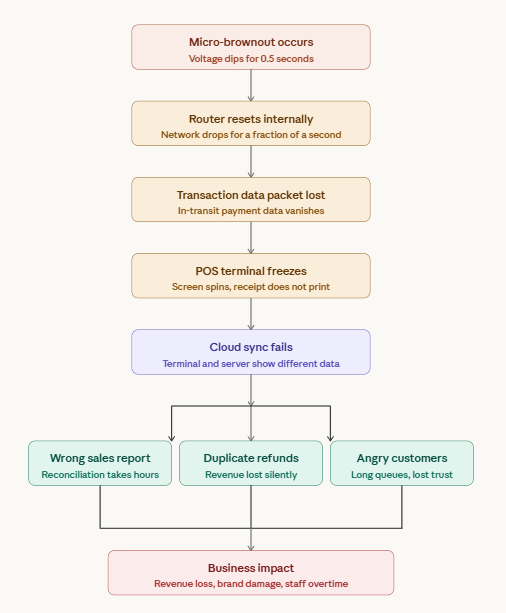
When a desync happens, the impact spreads across your operations. End of day sales reports no longer match payment gateway records, and reconciliation can take hours. Refunds may be issued for payments that were actually successful, while failed transactions might be entered again, sometimes more than once.
Inventory systems are also affected because stock updates depend on every sale. Incorrect data leads to inaccurate stock levels and potential supply issues. Meanwhile, customers who experience frozen systems or delayed confirmations may leave frustrated and choose not to return.
These problems rarely appear as a clear system error. Instead, they show up as customer complaints, accounting inconsistencies, and unexplained gaps in your weekly revenue.
Why Standard Power Strips and Surge Protectors Are Not Enough
Many retailers rely on surge protectors to safeguard their POS systems. While these devices block high voltage spikes, they do nothing for low voltage events.
Micro brownouts, brief dips in voltage, pass through surge protectors without any warning or protection. The real risk for modern POS setups is under-voltage, which conventional power accessories almost entirely ignore.
The Right Framework: UPS for Transaction Integrity, Not Just Uptime
At Right Power, retailers who experience Friday night system crashes often discover the same root cause. The issue is not the POS software, payment gateway, or internet connection. It is unstable power that cannot support continuous digital transactions.
A Uninterruptible Power Supply (UPS), when correctly specified for a retail POS environment, does something that no surge protector or stabiliser alone can do. It places a battery backed buffer between the incoming grid and your connected devices.
This allows routers, POS terminals, and network switches to continue receiving clean power even during micro brownouts. The purpose is not just to handle long blackouts. A UPS bridges short voltage dips lasting less than a second, ensuring transaction data reaches the server before the connection resets.
This invisible protection keeps receipts printing, transactions completing, and customers moving without disruption.
A Note on the Pre-Festive Season
March through May in Malaysia is a period of heightened retail activity — pre-Hari Raya shopping, school holiday spending, and the seasonal uptick that most retailers count on to meet their quarterly targets. Grid demand rises. Voltage stability drops. The probability of micro-brownouts increases precisely when your transaction volume is at its highest.
This timing is not a coincidence. It is a pattern we see every year, and it is entirely predictable.
Conclusion
The next time your POS system freezes during a busy night, resist the instinct to call your software vendor first. Instead, ask a simpler question. What was the power doing in the seconds before the freeze?
At Right Power, retail power solutions are built around a simple principle. In a cloud connected environment, power protection is not just about preventing shutdowns. It is about protecting the integrity of every transaction, from the moment a customer taps their card to when the data safely reaches your server.
Your POS system is only as reliable as the power it runs on.