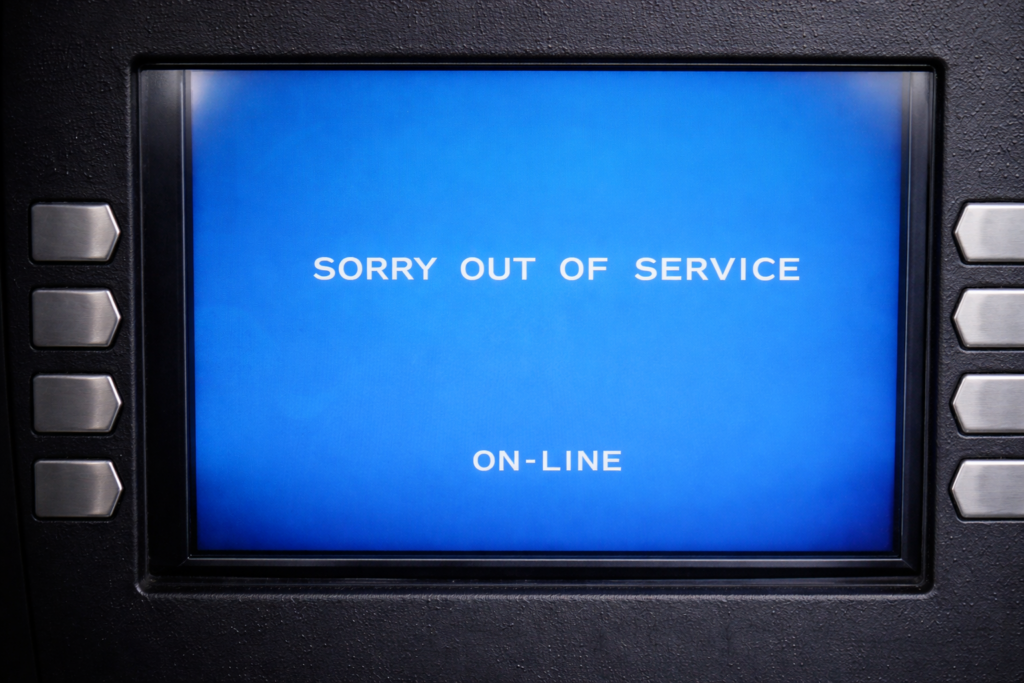
Picture this. It is a Sunday afternoon in a newly developed township outside Cyberjaya. A resident walks five minutes to the nearest ATM, the only one within a two kilometre radius, to withdraw cash before a family dinner. The screen is on, but the message reads, System Unavailable. Please try another machine.
There is no other ATM nearby. The resident drives ten minutes to the next town. Dinner is delayed and frustration builds.
Now imagine this same message appearing yesterday and the day before. For the bank whose logo sits above that ATM, this is more than a technical issue. While solutions exist, repeated unavailability could begin to affect how a community perceives the reliability of its banking access.
Malaysia’s ATM Expansion Into New Territory
Malaysia banking sector is undergoing a major infrastructure expansion. Financial institutions are deploying ATMs into newly developed areas such as Forest City in Johor, newer parts of Cyberjaya, and emerging townships across Selangor and Sabah to improve banking access for growing communities.
The intention is positive, but these locations often face a challenge that hardware investment alone cannot solve. Power quality in developing areas is usually less stable compared to established city centres.
Despite their rugged appearance, modern ATMs are highly sensitive to power fluctuations, making reliable power protection essential for consistent operation.
The Problem Nobody Talks About: Voltage Transients
Power problems are not always about power going on or off. In developing areas with active construction and growing infrastructure, power quality is often unstable in more subtle ways.
• What Is a Voltage Transient
A voltage transient is a sudden and extremely brief spike or fluctuation in power. It can last from microseconds to milliseconds but still disrupt sensitive equipment.
• Common Causes in Developing Areas
Voltage transients can be triggered by nearby construction machinery, transformer switching, lightning strikes, or large equipment starting up on the same grid.
• Invisible to Humans
These events usually go unnoticed. Lights do not flicker and most devices appear to operate normally.
• Highly Disruptive to ATMs
Modern ATMs contain sensitive electronics including card readers, currency validators, and communication modules. A voltage transient can disrupt these components like a brief electrical storm inside the system.
Why Dirty Power Triggers False Out of Service Errors
Modern ATMs are complex networked terminals. They run embedded operating systems, maintain encrypted connections, and perform constant self diagnostics. This makes them sensitive to power quality issues.
• Voltage Transients Cause False Alarms
A brief spike in voltage can trigger a sensor to register an unusual reading. The ATM interprets this as a potential hardware fault.
• Automatic Shutdowns
Designed for security and accuracy, the ATM takes itself offline and displays the System Unavailable message. The machine is not actually broken.
• Invisible and Repetitive Problem
Engineers inspect the ATM, find no fault, and restore it. Voltage transients can strike again within hours, repeating the cycle.
• A Hidden Operational Challenge
This invisible pattern of false errors and unnecessary service calls is a common but underreported issue for banks expanding into Malaysia’s newer growth areas.
The Long Term Consequence: Hardware Degradation
Beyond service interruptions, voltage transients cause gradual, costly damage to ATMs. Each spike adds small thermal and electrical stress to circuit boards, power supplies, and card and currency modules.
Individually, the damage is minor. Over weeks and months, it accumulates. Capacitors degrade early, communication modules develop intermittent faults, and card readers misread more often. A five-year hardware lifecycle can start behaving like three years without any single identifiable cause.
For banks managing dozens or hundreds of ATMs, these hidden stresses drive maintenance costs higher, creating a significant and avoidable expense.
The Availability Promise and What It Actually Requires
Every bank that deploys an ATM makes an implicit promise: the machine will be available when customers need it. In established cities this is easier, but in new, construction heavy areas, it requires careful planning.
• Understanding the Site
Right Power works with banks to assess the electrical environment before deployment. Key questions include the level of transient activity, required voltage conditioning, and the right mix of surge suppression, line filtering, and battery backup.
• Power Protection in Action
A properly specified setup filters electrical noise, stabilises voltage during brief fluctuations, and provides battery backed runtime to bridge interruptions without forcing a restart.
• Reliable ATM Operation
With this approach, ATMs stay online not because power problems never occur, but because they are absorbed before reaching sensitive hardware.
Trust Is Measured in Uptime
A bank’s reputation in a new community is shaped by simple experiences. Was the ATM working when needed? Could I access my money without driving elsewhere? Is the bank committed to this area or just passing through?
These questions are answered not by marketing or branch design but by whether the screen says Welcome or System Unavailable on a Sunday afternoon.
At Right Power, we see power quality as a front line customer experience issue. ATM hardware is only as reliable as the power that supports it, and uptime reflects how seriously a bank serves its community.